

From AI-ready files to AI-ready databases
AI agents become much more useful when they can work with real data. File-based workflows are often the first step: upload a Parquet, CSV, JSON, Excel, Avro, ORC, or Feather file and let an AI workflow inspect, search, and summarize it.
That is exactly why ParquetReader is evolving beyond a simple file viewer. With persistent files and API access, files can become reusable data sources for automation tools, n8n workflows, and AI agents.
But for many teams, files are only the beginning. The next question is: how do you safely connect AI agents to live internal databases?
The problem with giving AI agents direct database access
Modern AI tools can generate SQL, call APIs, inspect schemas, and reason over data. That is powerful, but it also introduces a serious security and governance problem.
You do not want raw database credentials copied into random AI tools. You do not want uncontrolled SQL execution. You do not want sensitive data pasted into chat interfaces. And you probably want to know which question produced which query, which rows were accessed, and which answer was returned.
Traditional BI tools solve part of this problem by turning data into dashboards. But dashboards take time to build, maintain, and change. AI agents promise a faster workflow: ask a question, inspect the relevant data, and get an answer. The missing piece is secure, governed access.
Introducing AgentDataGateway
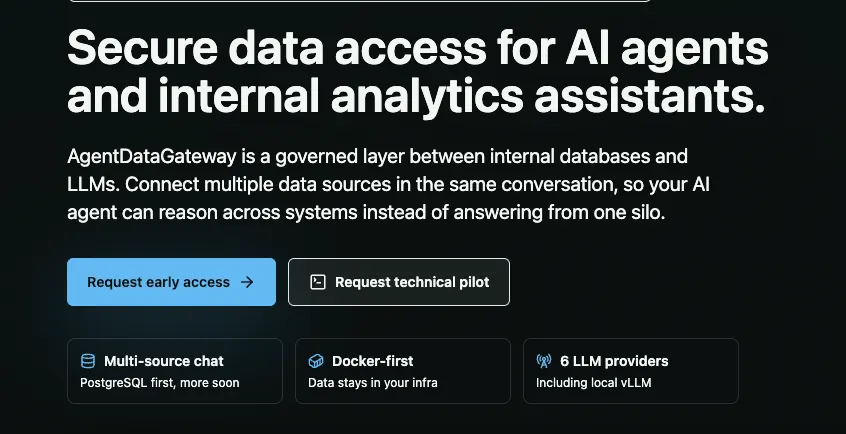
AgentDataGateway is an early-stage project exploring a secure data access layer for AI agents and internal analytics workflows.
The idea is simple: connect internal databases to LLMs and AI agents safely, without exposing raw credentials or giving agents uncontrolled access to company data.
Instead of positioning this as just another “chat with your database” tool, AgentDataGateway is designed as a governed gateway between internal data sources and AI-powered workflows.
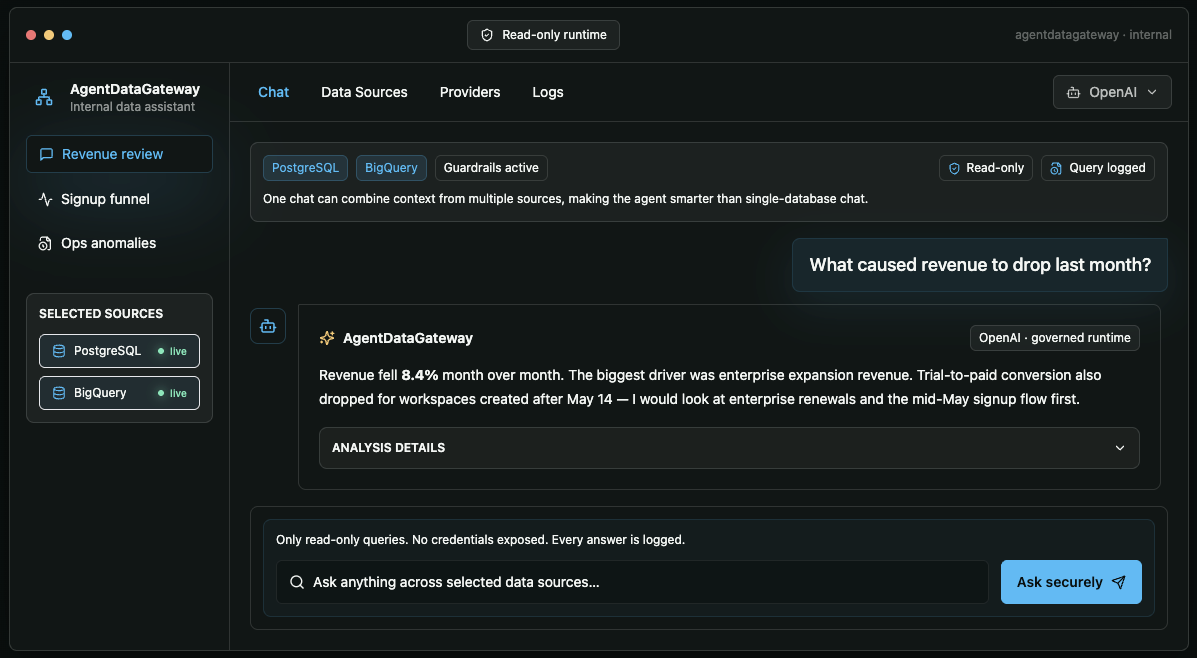
What AgentDataGateway is designed to do
AgentDataGateway is being designed as a self-hosted AI data gateway and AI-native analytics layer for internal company data.
A user should be able to connect a read-only data source, choose an LLM provider, start a chat, select which data sources the agent may use, and ask questions in natural language.
Behind the scenes, the gateway should help control how the agent accesses data: which sources are available, which credentials are used, which queries are executed, which limits apply, and which logs are stored.
Possible data sources and providers
The first version would likely focus on PostgreSQL, because it is widely used, well understood, and a practical starting point for secure read-only analytics.
Over time, the same concept could extend to MongoDB, MySQL, MariaDB, BigQuery, Neo4j, CosmosDB, vector databases, and other common internal data systems.
The goal is also to stay provider-agnostic. Teams should be able to use OpenAI, Anthropic, Google Gemini, Grok, custom OpenAI-compatible endpoints, or local/self-hosted models through runtimes such as vLLM.
Why self-hosted matters
For many companies, sending database traffic through a third-party SaaS platform is a difficult security conversation.
That is why AgentDataGateway is being explored with a self-hosted deployment model in mind. A Docker-based deployment with a license key could let teams run the gateway close to their own data, while keeping control over credentials, network access, logs, and provider configuration.
A managed SaaS version could still make sense later, but for serious internal data workflows, self-hosted or on-prem deployment may be the more trusted starting point.
How this is different from traditional BI
AgentDataGateway is not intended to simply replace tools like Power BI, Looker, or Tableau. Dashboards are still useful when teams need stable reporting, recurring metrics, and governed visualizations.
The opportunity is different: many business questions are ad-hoc, exploratory, or too small to justify building a dashboard. Teams often need quick answers from internal data before deciding whether a dashboard, report, or deeper analysis is worth building.
That is where AI-native analytics can be useful: ask a question, let an agent inspect the relevant data safely, review the generated query and audit trail, and continue the conversation.
Security principles behind the idea
Use read-only database users. The gateway should recommend and enforce least-privilege access wherever possible.
Do not expose raw credentials to agents. Credentials should be stored securely and never pasted into prompts.
Log queries and answers. Teams should be able to inspect what happened after an AI-generated answer was produced.
Control which sources are available. Not every chat or agent should have access to every database.
Add guardrails. Query timeouts, row limits, schema restrictions, and approval flows can help reduce risk.
Keep deployment flexible. Teams should be able to choose cloud LLMs, local LLMs, or custom provider endpoints.
Example use cases
A data engineer could connect a PostgreSQL replica and let internal teams ask operational questions without writing SQL manually.
A SaaS founder could use the gateway to explore product metrics, signup funnels, customer segments, and revenue movements without building dashboards for every question.
An AI engineer could connect internal data sources to an agent workflow while keeping credentials, query logs, and access rules under control.
A company experimenting with n8n, MCP-style workflows, ChatGPT, Claude, Gemini, or local LLMs could use a gateway layer to make database access safer and easier to govern.
Why we are validating this now
AgentDataGateway is still being validated. The goal is not to overbuild a full platform before understanding whether teams actually want this, which deployment model they prefer, and which data sources matter most.
Instead, we are starting with a landing page, product mockups, and direct feedback from technical users who are already thinking about AI agents and internal data access.
The most useful feedback is specific: which database would you connect first, which LLM provider would you use, would this need to be self-hosted, and would your team consider paying for a technical pilot?
Join the early access list
If your team is exploring AI agents, internal data assistants, AI-native analytics, or secure database access for LLM workflows, we would like to hear from you.
We are especially interested in teams that want to connect PostgreSQL, BigQuery, MongoDB, Neo4j, vector databases, or similar systems to AI workflows safely.
From ParquetReader to AgentDataGateway
ParquetReader helps people open, inspect, convert, query, and reuse file-based data. Persistent files and API access make those files more useful for automation and AI workflows.
AgentDataGateway explores the next layer: secure, governed access to live internal databases for AI agents and AI-native analytics.
Together, these ideas point in the same direction: making real data easier and safer to use in modern AI workflows.