

Why Data Formats Matter 📊
The world is generating more data than ever before. From real-time analytics to AI model training, businesses need efficient ways to store, retrieve, and process massive datasets.
Traditional formats like CSV and JSON struggle with performance and storage efficiency. They lack indexing, compression, and structured metadata, making them slow and costly for large-scale analytics.
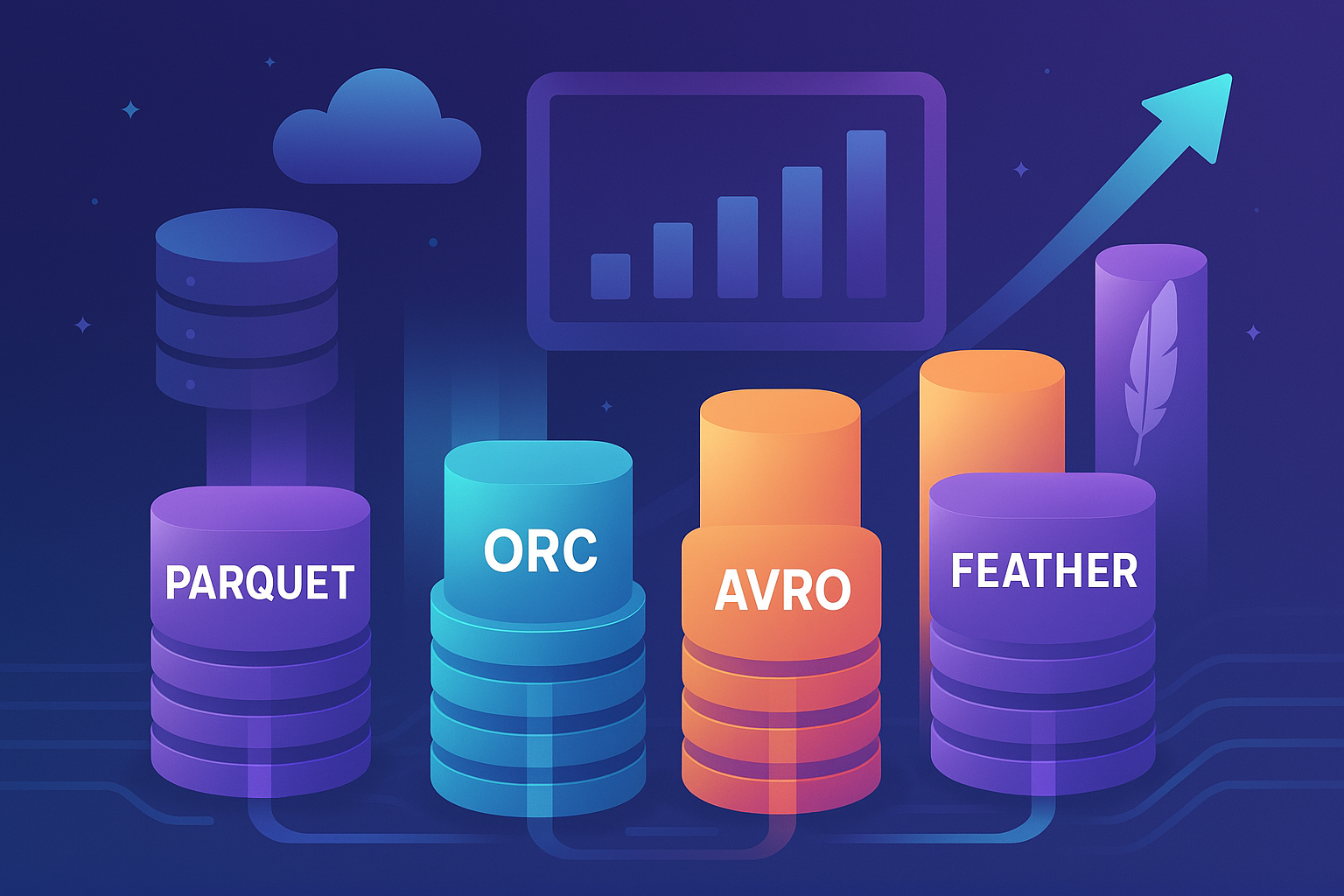
To solve these challenges, modern data formats like Parquet, ORC, Avro, and Feather have emerged—each optimized for specific workloads. But which one should you use? Let’s break it down.
Pros, Cons & Use Cases of Each Format 🏆
Parquet: The Columnar Storage Standard 📂
• Pros: Great for analytics, highly compressed, and widely supported across cloud platforms.
• Cons: Not ideal for small, frequent updates or streaming data.
• Use Case: Data warehouses and business intelligence tools, where query performance and compression are critical. Think of running SQL queries in BigQuery or Snowflake on millions of records efficiently.
ORC: High-Performance Big Data Format 🚀
• Pros: Optimized for big data processing, better indexing and compression than Parquet.
• Cons: Primarily built for Hadoop and Hive; less support outside that ecosystem.
• Use Case: Ideal for enterprise-scale big data environments like financial risk analysis or machine-generated logs in Hadoop.
Avro: Schema Evolution for Streaming Data 🔄
• Pros: Supports schema evolution, compact binary format, great for streaming and messaging.
• Cons: Not columnar, so slower for analytical queries.
• Use Case: Commonly used in Kafka pipelines where real-time data processing is needed. For example, a social media platform processing millions of real-time user actions.
Feather: Speed for Data Science Workflows ⚡
• Pros: Extremely fast, lightweight, and optimized for in-memory operations.
• Cons: Not suited for long-term storage or large-scale querying.
• Use Case: Ideal for machine learning & AI workflows in Python and R, enabling ultra-fast data interchange between Pandas and PyArrow.
The Role of These Formats in AI & Machine Learning 🤖
AI and ML models rely on vast amounts of structured data. Formats like Parquet and ORC provide efficient storage for training datasets, while Avro and Feather enable real-time model inference and experimentation.
For example, OpenAI's ChatGPT and other large language models (LLMs) require structured data for fine-tuning and optimization. By using these optimized formats, companies can speed up data pipelines for AI-driven analytics.
Tools like Hugging Face's datasets library leverage these formats to process terabytes of data efficiently. If you're working with AI, choosing the right format can save time and computational costs.
Why These Formats Are the Future 🔮
Parquet, ORC, Avro, and Feather have become industry standards for handling structured data efficiently. As the demand for scalable, high-performance data solutions grows, these formats will continue to shape the future of data engineering.
By adopting these modern file formats, businesses can improve query performance, reduce storage costs, and ensure seamless data interoperability across multiple platforms.
Try ParquetReader 🔎
Experience seamless data conversions with ParquetReader.